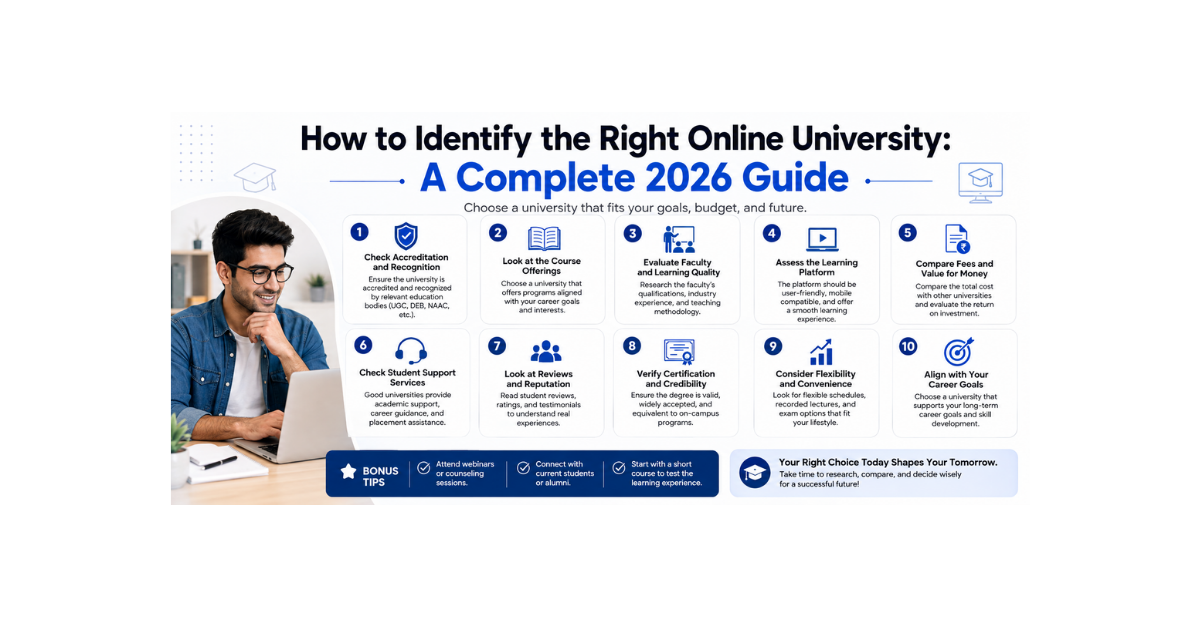
How to Identify the Right Online University
Selecting an online university seems similar to buying a bed from online stores. All the images are equally comfortable, all the sellers guarantee the best sleep ever, but you will only realize what you bought once you wake up to a bad surprise after spending decades with it. In case of bed it might be a matter of losing thousands of rupees, but in case of a diploma - years of your life.
So how can you actually differentiate a decent online university from a well-marketed scam? Let us see.
Why Picking the Right Online University Is Trickier Than It Looks
There has been rapid expansion of online education in India, and along with that expansion has come a deluge of choices. While some of these programs were indeed conceived keeping the students' best interests at heart, there are others that have come into existence for the purpose of filling enrollment figures.
The challenge lies in the fact that both these categories of online courses tend to present themselves in exactly the same manner on a website, including attractive banners, raving testimonials, and a countdown clock reminding you that the offer expires tonight.
Ready to Start Your Admission?
Fill in your details and our counsellors will guide you for free.
100% free, no spam. We respect your privacy.
Check University Approvals and Recognition
This is where your research should start, not end.
Why This Step Comes First
In case the programs offered by a university online do not receive recognition from the concerned body, like UGC or DEB, then no other aspect of that course becomes relevant at all. The best LMS and the most friendly faculty will not do any good to you if the degree you earn is not legitimate.
Program-Specific Approvals Matter Too
What many people don’t realize is that while the institution itself may have accreditation status, the individual online course program might not be accredited at all. People tend to focus on “is this university accredited?” but instead need to ask “is this individual online program accredited?”
Look at Placement Assistance Carefully
Every second ad you'll see promises "100% placement." Take a breath before you believe it.
What "100% Placement" Ads Usually Hide
That phrase rarely means "100% placement assistance" and not "100% guaranteed job." "Assistance" is the support. "Assistance" does not mean a job offer with your name on it. Universities, which confuse these concepts in their marketing, are often those universities that you need to consider more, not less.
What a Real Placement Cell Offers
Instead of trusting the slogan, check what's actually behind it:
-
A dedicated placement or career team, not just one overworked staff member
-
Active job portals and real openings, not a stale list from two years ago
-
Resume-building support
-
Interview preparation sessions
-
Mock interviews
-
Industry connections that lead somewhere
-
Internship opportunities
If a university can't clearly explain what its placement support includes, that silence tells you something.
Can You Actually Study Completely From Home?
Isn’t “online” meant to imply you don’t need to be anyplace at all? Well, you would expect so, but not every online program fulfills this expectation.
A well-designed online class gives you the ability to do all the aforementioned things from where you are, without the need for purchasing any train tickets or securing last-minute accommodation.
Watch Out for Hidden Campus Visit Requirements
A few courses have mandatory campus visits that are required for specific modules or exams. It is not a problem in itself, but it is important to know about it prior to applying; otherwise, in the fourth month of your course, an email will be sent asking you to attend in person.
Check the Online Learning Platform
The learning management system, or LMS, is basically your classroom now. If it's clunky, your entire experience suffers, no matter how good the course content is.
Features That Separate a Good LMS From a Bad One
Before enrolling, check whether the platform gives you:
-
Live classes
-
Recorded lectures you can revisit
-
E-books and study material
-
Assignment submission tools
-
Discussion forums for peer interaction
-
Progress tracking
-
A real way to reach faculty with questions
Ask for a demo if you can. A platform that looks fine in a promotional video can feel completely different once you're actually using it daily.
Understand the Examination Process
Exams are where a lot of online students get caught off guard.
Proctoring, Centres, and Internal Assessments
Learn the precise nature of the exam process. Is it purely online with remote proctoring via your computer's webcam? Do you have to physically go to an examination center for it? How stringent is the proctoring software and what will happen if you get disconnected in the middle of the exam?
In addition, find out how much weightage is there between internal and end-of-term exams. In some courses, the internal assessments form a major part of the grades, whereas some depend purely on the end-of-term exam.
Begin Your Journey with the Right Degree
Fill in your details and our counsellors will guide you for free.
100% free, no spam. We respect your privacy.
Compare Fees and EMI Options
The Fee Structure Trap
This does not give you the entire story about the number. Ensure you ask for the fee structure in its entirety to include fees for the examination, registration, certification, and any other possible charge. You will realize that the cheaper course ends up being more expensive.
Loan and Payment Flexibility
Once you know the real total, check the payment options:
-
No-cost or low-cost EMI plans, where available
-
Monthly payment structures
-
Education loan tie-ups
-
Flexible payment schedules that match your income pattern
If you're working while studying, spreading payments out often matters more than the total amount itself.
Check the Course Curriculum
A known degree will give you access to a good place, but the curriculum will make sure that you are really ready after finishing it. See if the courses offered have to do with current things in your field of study, and not things that happened years ago. See if there are any hands-on projects, electives, internships, and specializations. The fact that the curriculum is stuck in 2015 means a lot, even if the university itself is famous.
Evaluate Faculty and Academic Support
Who is really teaching you? Research about the teaching background of the faculties and not just their fancy titles. Find out if there are doubt-clearing classes and their frequency. The importance of academic counseling and promptness in replying to student doubts will be realized only when the time comes when you are stuck on something at 11 p.m.
Check Student Reviews Carefully
Reviews on a university's own website are basically a highlight reel. Nobody puts the bad ones there.
Where to Look Beyond the University's Own Website
Find common threads in feedback from different independent forums and social media groups where students discuss their experiences. Things like complaints about poor customer service, confusing examination dates, and non-responsive professors often recur when they actually exist as problems. One complaint from an irate user may not mean much, but ten of the same complaints should be taken seriously.
Check Degree Validity and Recognition
This needs to be pointed out since there are some misconceptions here. The general recognition of a university doesn't necessarily imply that each and every online course offered by this university will have the same level of recognition. Make sure that the particular online course you are enrolling into is recognized or eligible for your purposes, such as government employment, higher education, or private-sector employment.
Check Career and Skill Development Support
Beyond placement cells, look for the extras that actually build your profile over time:
-
Career counselling sessions
-
Industry webinars with real practitioners
-
Certifications that add value to your resume
-
Skill-development programs alongside your core subjects
-
LinkedIn and resume support
-
Internship assistance
-
Placement preparation beyond just interview tips
These things sound minor individually, but together they shape how ready you are when you finally start job hunting.
Check Flexibility for Working Professionals
In case you’re managing work while studying at the same time, being flexible shouldn’t be an extra but the main priority for you. It’s important to look for online courses with lectures that can be watched out of working hours, mobile availability that won’t require you to stay near the computer, as well as homework deadlines that take into consideration your busy schedule.
Quick Identification Checklist
|
What to Check |
What You Should Look For |
|
Recognition |
UGC/DEB status and applicable approvals |
|
Placement |
Placement assistance plus real career services |
|
Learning |
Live and recorded classes |
|
Location |
Ability to study fully from home |
|
Exams |
Clear online or proctored exam process |
|
Fees |
Transparent total fee, not just the headline number |
|
EMI |
Flexible EMI or payment options |
|
Curriculum |
Industry-relevant subjects and projects |
|
Faculty |
Qualified and genuinely accessible faculty |
|
Support |
Academic and technical assistance |
|
Career |
Internships, resume, and interview support |
|
Flexibility |
Suitable for working professionals |
|
Reviews |
Independent student feedback, not just testimonials |
|
Degree |
Validity and recognition of the specific program |
Conclusion
Do not choose an online university based on how cheap the fee is or due to a promise of “100% placement” in bold font. First establish the recognition, then check out the mode of learning, the exam system, career services, actual fee pattern, EMI facilities, quality of the syllabus, and student services. It will be harder in the beginning, true, but it will hurt a lot less than finding out after six months that you made a wrong choice. Consider this list as a filter and pass all selected universities through it before paying a single rupee; you’ll end up saving yourself from a lot of heartache.
Frequently Asked Questions
1. How do I check if an online university is UGC or DEB approved?
Visit the official UGC-DEB website and search for the university's name in the approved list, or ask the university directly for their approval letter for that specific program.
2. Does "100% placement assistance" mean I'm guaranteed a job?
No. It means the university will support your job search through resources like resume help and interviews, but it doesn't promise an actual job offer.
3. Are online degrees valid for government jobs?
It depends on the specific program's recognition. Some online degrees are accepted for government roles while others aren't, so always confirm this before enrolling.
4. What should I check about the LMS before enrolling?
Ask whether it offers live classes, recorded lectures, downloadable study material, assignment submission, discussion forums, and faculty interaction, and request a demo if possible.
5. How are online exams usually conducted?
Most online universities use remote proctoring through your webcam, though some require a visit to a designated exam centre. Always confirm this before you enroll.
6. Is the advertised course fee usually the total cost?
Often not. Ask for a full breakdown including exam fees, registration charges, and certification costs to avoid surprises later.
7. Can I pay online university fees in EMIs?
Many universities offer no-cost or low-cost EMI options, along with education loan partnerships, though this varies by institution.
8. How important is the curriculum compared to the university's brand name?
Very important. A recognized degree with an outdated curriculum can leave you underprepared, so check for current, industry-relevant content and practical components.
9. Where should I look for genuine student reviews?
Check independent review platforms, education forums, and social media groups rather than relying solely on testimonials on the university's own website.
10. Do online universities require any campus visits?
Some do, for specific modules, workshops, or exams. Confirm this upfront rather than assuming everything is fully remote.
11. What academic support should I expect from a good online program?
Look for accessible faculty, regular doubt-solving sessions, academic counselling, and reasonably quick responses to student queries.
12. Are online degrees suitable for working professionals?
Yes, provided the program offers recorded lectures, flexible schedules, mobile access, and realistic assignment deadlines that fit around a job.
13. How can I verify if a specific program is recognized, not just the university?
Ask the university for written confirmation of the specific program's recognition status, since general university recognition doesn't always cover every course.
14. What career support beyond placements should I look for?
Career counselling, industry webinars, certifications, skill-development sessions, resume and LinkedIn support, and internship assistance all add real value.
15. What's the biggest mistake students make when choosing an online university?
Trusting advertised claims like low fees or "100% placement" without verifying recognition, curriculum quality, exam process, and independent student reviews first.