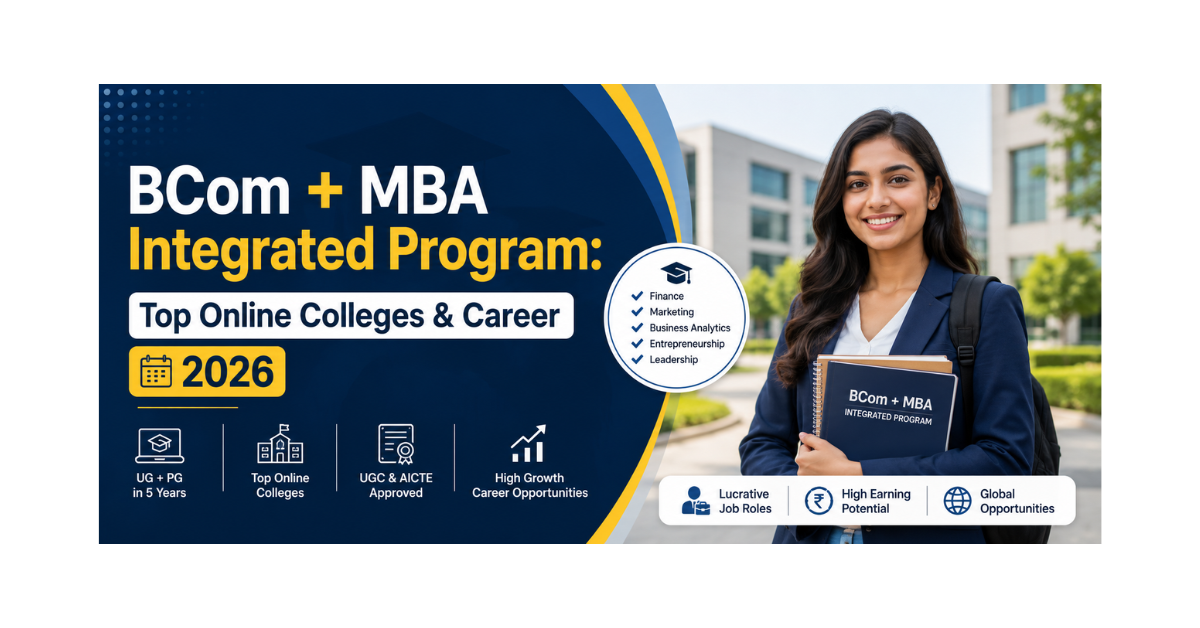
BCom + MBA Integrated Program: Top Online Colleges & Career 2026
Picture this. You finish Class 12, you know you want a solid career in business or finance, and someone tells you there are two ways to get there. Option one: spend three years on your BCom, take a year off, crack an MBA entrance exam, and then grind through two more years of postgraduation. That's six years minimum, possibly seven if life gets in the way. Option two: enroll in a single integrated program, study without interruption, and walk out in five years holding both a BCom and an MBA.
Which one makes more sense to you?
For a growing number of students in India and abroad, the answer is obviously option two. The BCom plus MBA Integrated Program has quietly become one of the most practical academic decisions a commerce student can make in 2026. It saves time, saves money, and puts you on a career track faster than most of your peers will even finish their graduation.
This article breaks down everything you genuinely need to know before you commit to this path, from how the program works and which online colleges are actually worth your time, to what career doors it opens and how much you can realistically expect to earn.
What Exactly Is a BCom + MBA Integrated Program?
A BCom plus MBA Integrated Program is a single continuous academic course that awards you both a Bachelor of Commerce degree and a Master of Business Administration degree under one enrollment. You apply once, you study without interruption, and you graduate with two qualifications after five years.
Secure Your Admission in Top Online Universities for 2026
Fill in your details and our counsellors will guide you for free.
100% free, no spam. We respect your privacy.
This is not a shortcut or a discounted version of either degree. The curriculum covers all the core subjects of a standalone BCom in the first three years and transitions into full MBA-level content in the final two years. The key advantage is that the transition is smooth and intentional. Universities design the program so that your commerce foundation directly feeds into your management studies, which means you're not relearning basics when you enter the MBA phase.
How This Differs from the Traditional Route
When you pursue BCom and MBA as separate programs, you deal with two separate admissions, two separate fee structures, and a gap period between the two degrees where many students lose momentum or shift directions entirely. The MBA entrance exam cycle alone, including preparation time, application fees, and coaching, can add six to twelve months to your timeline.
In an integrated program, all of that disappears. You're on one academic journey from day one. There's no re-application, no entrance exam for the MBA phase (since you've already enrolled), and no gap year that can derail your plans.
Program Duration and Semester Structure
Most BCom plus MBA Integrated programs run across five years divided into ten semesters. Semesters one through six cover the BCom curriculum, while semesters seven through ten deliver the MBA content. Some universities break this into a 3 plus 2 structure where you formally receive your BCom at the end of year three and your MBA at the end of year five.
Specialization options typically open up in the seventh or eighth semester, letting you focus on areas like Finance, Marketing, HR, Operations, or International Business during the final stretch of the program.
Real Reasons Students Are Choosing This Path in 2026
Students are not choosing this program because it sounds good on paper. They're choosing it because it makes practical financial and career sense. Here's what's actually driving that decision.
The Financial Logic Behind It
A standalone MBA from a reputed private university in India can cost anywhere between Rs. 3 lakh and Rs. 15 lakh depending on the institution and mode of study. Add BCom tuition, hostel fees if applicable, and exam coaching expenses, and you're looking at a combined outlay that can stretch well beyond Rs. 10 lakh over six or seven years.
Integrated programs, especially in online mode, bundle everything into a significantly lower total fee. Many online integrated programs cost between Rs. 50,000 and Rs. 2.5 lakh for the entire five-year course. That's not just a saving. For many middle-class Indian families, that difference determines whether higher education is accessible at all.
Getting a Head Start on Management Thinking
One thing students who've gone through this program consistently say is that being introduced to management subjects in year three or four changes how they think. By the time they reach their MBA phase, they're not learning concepts cold. They're applying them to a business framework they've already started building. That context makes the MBA content click faster and stick longer.
Why Commerce Background Gives You an Edge
A BCom student stepping into an MBA program already understands financial statements, taxation structures, business law, and cost accounting. These aren't abstract concepts to them. This matters enormously in MBA subjects like Financial Management, Strategic Management, and Business Analytics, where students without a commerce background often struggle in the first semester. Your BCom training essentially gives you a running start.
Who Can Apply? Eligibility Breakdown
Eligibility requirements are generally clear and accessible across most institutions offering this program.
The basic requirement is completion of Class 12 from a recognized board, ideally in the Commerce stream. Most universities ask for a minimum aggregate of 45% to 55% in Class 12, though this threshold varies. Some institutions are stricter with top-ranked programs, while distance learning universities tend to be more flexible to improve accessibility.
Students from Science and Arts backgrounds can also apply at many universities, particularly if they've studied Mathematics or Economics as a subject. This makes the program available to a broader pool of applicants who are looking to transition into a commerce or management career.
For online programs specifically, age relaxations and working professional exemptions are often available, meaning someone who took a break after Class 12 and wants to restart their education can still apply.
Top Online Colleges for BCom + MBA Integrated Programs in 2026
Online education in India has reached a point where the quality of instruction, course materials, and student support is genuinely comparable to many campus programs. The following universities have earned their reputation through consistent results, proper accreditation, and strong student feedback.
IGNOU
IGNOU, the Indira Gandhi National Open University, is the largest open university in the world by enrollment. Its programs are UGC-recognized and follow Distance Education Bureau guidelines, which means a degree from IGNOU carries formal validity across India. IGNOU's BCom and MBA programs are available in distance mode and are among the most affordable higher education options in the country. Students across remote and semi-urban areas have built careers through IGNOU degrees, which speaks to its reach and reliability.
Sikkim Manipal University Distance Education
SMU-DE has built a consistent track record in distance and online management education. Their BCom and MBA programs are structured for students who need flexibility without compromising on curriculum quality. The university regularly updates its course content to reflect industry changes, which is something students in the MBA phase particularly appreciate. Faculty credentials and student support resources are among the stronger aspects of this institution.
Jain University Online
Jain Online has invested heavily in its digital learning infrastructure. Live sessions, recorded lectures, discussion forums, and dedicated academic mentors are standard features of their programs. Their MBA specialization options are diverse and industry-aligned, covering areas like Business Analytics, Digital Marketing, and International Finance, which are fields seeing genuine hiring growth in 2026.
Amity University Online
Amity carries brand recognition that employers in India and internationally respond to positively. Their online programs maintain the same academic standards as their campus equivalents, which is not always true of universities that treat distance learning as an afterthought. Amity Online also has active placement support, including virtual career fairs and resume review services for enrolled students.
Lovely Professional University Online
LPU's online platform is one of the more student-friendly systems among Indian universities. Live doubt sessions, one-on-one faculty consultations, and peer learning groups are built into the learning experience. Their placement ecosystem, built through the main campus, extends to online students as well, which gives LPU Online graduates access to a wide employer network.
How to Match a College to Your Personal Goals
Each of these universities brings something different. IGNOU is the best choice if cost and accessibility are your primary concerns. Amity works best if brand recognition matters for the industry you're targeting. Jain and LPU are strong choices if you want modern curriculum delivery and strong student support. SMU is reliable for students who want a structured program with clear academic milestones.
What You Actually Study: Semester-by-Semester Breakdown
Understanding the curriculum helps you make a more informed decision and prepares you mentally for what's ahead.
First Three Years: The Commerce Core
The initial six semesters build your commercial and financial literacy through subjects like Financial Accounting, Business Mathematics and Statistics, Principles of Economics, Microeconomics and Macroeconomics, Corporate Law, Business Regulations, Direct and Indirect Taxation, Cost Accounting, Financial Management, Computer Applications in Business, and Principles of Management.
By the end of year three, you have a working knowledge of how businesses operate from a financial and legal standpoint. This is the foundation that makes the MBA phase more effective.
Final Two Years: The MBA Layer
Semesters seven through ten shift the focus from understanding to leading. Core subjects typically include Strategic Management, Marketing Management, Human Resource Management, Operations and Supply Chain Management, Business Analytics, Organizational Behavior, Entrepreneurship and Innovation, International Business, Research Methodology, and Business Ethics.
Most programs include a mandatory internship, live project, or dissertation component in the final semester, which serves as your bridge between academic learning and professional application.
Online vs. Campus Programs: An Honest Comparison
Neither format is universally better. Each suits a different type of learner in a different life situation.
Campus programs offer structured schedules, face-to-face interaction with faculty and peers, physical networking opportunities, and the social dimension of university life. If you're fresh out of Class 12, have the financial means, and want the full university experience, campus learning has genuine value.
Apply Only to Verified UGC-Approved Universities
Fill in your details and our counsellors will guide you for free.
100% free, no spam. We respect your privacy.
Online programs offer location flexibility, lower cost, and the ability to study alongside part-time work or family responsibilities. The quality of online learning in 2026 has improved significantly. Platforms now include live video classes, real-time Q&A, collaborative group projects, and direct faculty messaging. If you're disciplined and clear about your learning goals, an online integrated program can deliver outcomes that rival a campus experience at a fraction of the cost.
Step-by-Step Admission Process
The admission process for online integrated programs is fairly standardized across most institutions.
Start by visiting the official website of your chosen university and verifying its UGC recognition and DEB approval status before filling any form. Download or read the program brochure carefully to confirm the curriculum matches your expectations. Fill out the online application form and upload required documents, which typically include Class 10 and Class 12 mark sheets, a government-issued ID proof, and a recent passport-size photograph.
Some universities conduct a basic aptitude test or video interview as part of the selection process. Others offer direct merit-based admission. Once your documents are verified and your fee payment is confirmed, you receive enrollment credentials and access to the university's learning management system, usually within one to two weeks.
Fee Structure, EMI Options, and Scholarships
Total program fees for online BCom plus MBA Integrated programs generally range from Rs. 40,000 to Rs. 2.5 lakh across the five-year duration. This wide range reflects the significant differences between institutions. IGNOU sits at the lower end. Private universities like Amity and Jain sit toward the middle to upper end.
Most universities offer semester-wise or annual payment options rather than requiring the full fee upfront. EMI facilities through partnered financial institutions are increasingly common and genuinely helpful for students managing limited budgets.
Scholarships are available at almost every institution. These are typically merit-based, awarded on Class 12 percentage, and applied at the time of admission. Some universities also offer need-based financial aid. The important habit here is to check the scholarship section of the official university website before applying, because many eligible students simply miss out because they don't look.
Career Paths After BCom + MBA: What the Job Market Looks Like
The degree combination is genuinely versatile, which is one of its strongest selling points.
High-Demand Job Roles in 2026
Graduates of this program are actively placed in roles like Financial Analyst, Business Development Manager, Marketing Manager, Tax Consultant, Human Resources Manager, Operations Manager, Investment Banking Analyst, Management Consultant, Product Manager, and Supply Chain Analyst.
Industries Actively Hiring These Graduates
Banking and Financial Services, Information Technology and IT-enabled Services, E-commerce and Retail, Management Consulting, Healthcare Administration, Fast-Moving Consumer Goods, Manufacturing, and Government and Public Sector Enterprises all regularly recruit BCom plus MBA graduates.
Realistic Salary Figures for 2026
Entry-level salaries in India for fresh BCom plus MBA graduates typically range from Rs. 4 lakh to Rs. 8 lakh per annum. This figure depends heavily on the university's reputation, your chosen specialization, and the city where you're applying. Finance and analytics roles tend to command higher starting packages. With three to five years of experience, professionals in this profile regularly earn between Rs. 12 lakh and Rs. 20 lakh annually. International roles, particularly in Gulf countries and Southeast Asia, offer different pay scales that are often significantly higher in absolute terms.
UGC, DEB, and AICTE Recognition: Why It Matters
Recognition is not a formality. It is the difference between a degree that opens doors and a certificate that raises questions.
A degree from a UGC-recognized university that follows Distance Education Bureau guidelines is accepted by government employers, private companies, and higher education institutions for further studies. An unrecognized degree, regardless of how impressive the curriculum or faculty looks, carries no legal or academic standing.
Before enrolling in any online program, visit the UGC website at ugc.ac.in and the DEB portal at deb.ugc.ac.in and verify the institution's approval status directly. Some MBA programs also carry AICTE approval, which adds another layer of credibility, particularly for roles in public sector banks and government undertakings.
Do this verification step before you pay any application fee, not after.
How to Pick the Right Online College Without Getting Misled
The online education market in India has grown rapidly, which unfortunately means there are institutions that market aggressively but deliver poorly. Here is how you protect yourself.
Verify UGC and DEB recognition on official government portals, not just on the university's own website. Check the actual placement records, not placement claims. Ask for the names of companies that have recruited from the program and verify whether those companies actually hire management graduates at the salaries claimed. Read student reviews on independent platforms like Shiksha, CollegeDunia, and Trustpilot. Look at how long the university has been offering this specific program. A five-year track record is more meaningful than a recently launched course with no graduates yet. Evaluate the learning management system by requesting a demo session before enrolling.
Habits That Actually Help You Succeed in Online Learning
Online learning places a much higher responsibility on self-management than campus education does. Students who succeed in online programs tend to share a few consistent habits.
They create a dedicated study schedule and treat it with the same seriousness as a physical class. They engage actively in live sessions rather than defaulting to watching recordings passively. They use assignment deadlines as minimum targets, not final targets, finishing work early to allow time for review. They build relationships with faculty through email or messaging tools rather than staying invisible throughout the program. They supplement course content with industry reading, case studies, and business news to connect theory with what's happening in real markets.
BCom + MBA vs. BBA + MBA: An Honest Side-by-Side
Students often compare these two pathways when making their decision, and the honest answer is that both have genuine merit depending on what you want from your career.
BBA introduces management concepts from year one, which means by the time you reach the MBA phase, you have three years of management thinking behind you. This makes BBA plus MBA a slightly stronger option for students targeting general management, consulting, or entrepreneurship roles.
BCom builds deep competence in accounting, taxation, financial law, and business economics over three years. This makes BCom plus MBA the stronger choice for students targeting finance, banking, investment analysis, tax consulting, or any role where financial literacy is a core job requirement rather than a supporting skill.
Neither path is objectively better. The right choice depends on what industry and function you want to build a career in.
Where This Degree Takes You in the Next 5 to 10 Years
The business environment in 2026 is being reshaped by digital transformation, global supply chain restructuring, fintech growth, and a sharp increase in demand for data-literate business professionals. BCom plus MBA graduates are well-positioned for this environment because their training bridges financial literacy and strategic thinking, which is exactly the combination emerging industries are looking for.
Career growth trajectories for this profile are strong. Many graduates move into senior management roles within six to eight years of entering the workforce. Others leverage the dual qualification to pursue entrepreneurship, with the financial acumen from BCom and the strategic toolkit from MBA working together to support business building.
For those interested in further academics, this degree also qualifies you for PhD programs in Management, Commerce, or Business Administration at most Indian and international universities. Professional certifications like CFA, CPA, CMA, or digital marketing and data analytics credentials pair well with this qualification and can significantly increase your market value.
Conclusion
The BCom plus MBA Integrated Program is one of the most genuinely useful academic decisions available to commerce students in 2026. It combines two degrees into one uninterrupted journey, cuts down on time and cost in a meaningful way, and delivers a graduate who understands both the financial foundations and strategic demands of modern business.
Get Up to 20% Scholarship
Fill in your details and our counsellors will guide you for free.
100% free, no spam. We respect your privacy.
The online format, when chosen from a properly recognized institution, makes this program accessible to students regardless of geography, family income, or whether they need to work while studying. The key is doing your homework before enrolling, verifying accreditation, comparing curricula, and choosing the institution that aligns with where you want to go professionally.
If you're a commerce student reading this and still on the fence, here's the honest takeaway: the degree works if you work. The credential opens doors, but your consistency, curiosity, and discipline are what keep you walking through them.
FAQs
1. Is a BCom + MBA Integrated degree equal in value to doing BCom and MBA separately? Yes, provided the degree is from a UGC-recognized institution. Employers and academic institutions treat both pathways equally when the accreditation is valid.
2. Can I join this program right after Class 12? Yes. This is the standard entry point for the program. Students enroll directly after completing their Class 12 board exams.
3. Which stream should I have in Class 12 to be eligible? Commerce is the preferred stream, but students from Science and Arts backgrounds can also apply at many universities, particularly if they've studied Mathematics or Economics.
4. How do I verify if an online university is UGC-recognized? Visit ugc.ac.in and deb.ugc.ac.in directly and search for the institution by name. Do not rely solely on the university's own claims about recognition.
5. Is the BCom + MBA Integrated degree valid for government job applications? Yes, degrees from UGC-recognized institutions that follow DEB guidelines are accepted for government employment and competitive examinations.
6. What is the average total fee for an online BCom + MBA Integrated program? Total fees range from approximately Rs. 40,000 at institutions like IGNOU to Rs. 2.5 lakh at private universities like Amity or Jain, across the full five-year duration.
7. Can I work part-time while pursuing this program online? Yes. The flexibility of online learning is specifically designed to accommodate students who are working, managing family responsibilities, or living in locations without nearby campus access.
8. What specializations can I choose in the MBA phase? Common specializations include Finance, Marketing, Human Resources, Operations Management, International Business, Business Analytics, and Digital Marketing, depending on the university.
9. Are placements available for online students? Universities like Amity, LPU, and Jain actively extend placement support to online students through virtual drives, resume services, and employer tie-ups. The level of support varies by institution.
10. How is the BCom + MBA better than just doing a BCom followed by a regular MBA? The integrated route saves one to two years, reduces overall cost, eliminates the re-application and entrance exam cycle, and ensures a curriculum designed to build progressively without redundancy.
11. What is the minimum Class 12 percentage required to apply? Most universities require between 45% and 55% aggregate in Class 12. IGNOU and some distance learning universities have lower thresholds to improve accessibility.
12. Does AICTE approval matter for an MBA program? AICTE approval adds credibility and is often required for eligibility in public sector bank recruitment and some government roles. Check whether your MBA program carries AICTE recognition in addition to UGC and DEB approval.
13. Can I pursue a PhD after completing this integrated program? Yes. A BCom plus MBA from a UGC-recognized institution qualifies you for PhD admissions in Commerce, Management, or Business Administration at most Indian and international universities.
14. Is the curriculum of an online BCom + MBA the same as a campus program? At most reputed universities, the core curriculum is identical. The delivery format differs, with online programs using digital platforms, live sessions, and recorded content instead of physical classrooms.
15. What professional certifications go well with a BCom + MBA degree? Certifications that complement this degree well include CFA (Chartered Financial Analyst), CPA (Certified Public Accountant), CMA (Cost Management Accounting), and professional courses in Data Analytics, Digital Marketing, and Project Management.